Category: Parenting

2
January 16, 2026 by Admin 0 Comments

Anybody Can Serve: Building Big Hearts With Sparkler

Dr. Martin Luther King, Jr. taught people that all people can be great because “anybody can serve.” For young children, service doesn’t start with grand gestures — it begins with simple, everyday moments of helping, sharing, noticing others, and practicing kindness.

On the Sparkler mobile app, families can find manageable AND meaningful activities that they can do with their young children to turn everyday moments into powerful learning experiences, supporting children’s social, emotional, and cognitive development. 

Many Sparkler activities invite families to explore what it means to be a helper in age-appropriate, joyful ways.

In Let’s Help, children walk outside with a caregiver and look for small ways to help — picking up trash, holding a door, or helping a neighbor carry bags. These experiences build social-emotional skills like empathy and self-awareness while helping children understand that their actions matter. When adults ask, “How do you feel when you help others?” children begin to connect service with positive emotions and a sense of belonging.

Activities like Helpers United and Thank a Helper help children notice and appreciate the people who make their communities work: teachers, sanitation workers, crossing guards, delivery drivers, and neighbors. Creating a collage of helpers or thanking someone in real life strengthens children’s language skills, memory, and social understanding. It also builds respect for others and helps children see themselves as part of a larger community where everyone plays an important role.

Sparkler also encourages families to reflect and plan together. In How to Help and Who Needs It?, children brainstorm ways to help at home or in the community — cleaning up toys, donating clothes, or making a thank-you card—and even draw a “helper plan” to hang up as a reminder. These activities support early executive function skills like planning, decision-making, and follow-through, while reinforcing values of generosity and responsibility.

Creative and playful activities such as Kindness Chain Reaction and Friendship Cookie show children how kindness and sharing can grow. Making a paper chain for each kind act or dividing a giant cookie so everyone gets a piece introduces early math concepts like counting and fairness, while also teaching cooperation and compassion. Children learn that small actions—sharing a toy or offering a compliment—can have a big impact.

Finally, activities like Say It Loud and the Little Helpers, Big Impact invite children to find their voices and see themselves as changemakers. Chanting rhymes about standing up for what’s right or listening to stories of kids helping their communities builds confidence, language skills, and a sense of agency.

These Sparkler activities — and many others — help families show children that service isn’t something we wait to do when we’re older. It’s something we practice every day — at home, on the sidewalk, and in our neighborhoods.

By nurturing empathy, kindness, and community awareness early on, families are helping children grow into caring, capable people who know that anybody, no matter how small, can serve.

How to Find Sparkler Activiites

Families, search for activities in your Sparkler mobile application! Once you try it, remember to press “We Did It!” to earn Sparkles (points) and keep track of what you accomplish together. 

Providers — such as teachers and home visitors — who use Sparkler’s web-based dashboard can find these and other activities in Sparkler’s Library. Please search by the activity’s title to find what you’re looking for and share it with families!

IMG_3091
January 16, 2026 by Dana Stewart 0 Comments

Simple Ways Families with Young Children Can Give Back

By Dana Stewart, Director of Education, Sparkler Learning

Before I became a parent, I would spend Martin Luther King Jr. Day volunteering at my local library, park, or food pantry. As a school leader, I would organize coat and diaper drives to encourage the families at my center to support others in their community. Like many, I believe that one of the best ways to honor Dr. King’s legacy is by finding ways that we can be of service to others.

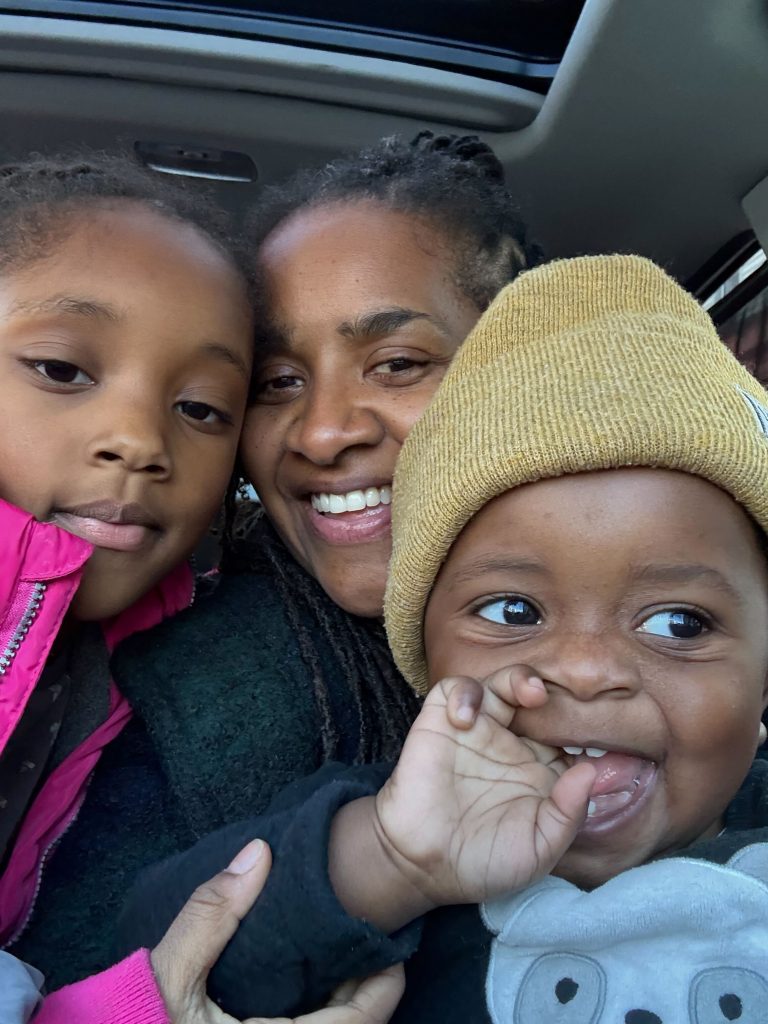
Now, as a mom to a 1-year-old and a 5-year-old, I’ll be honest, sometimes the idea of “giving back” can feel overwhelming. Raising young children is a fulltime job. My days are full and my energy is limited. Even leaving the house can feel like a major undertaking. It’s understandable that many parents think that community service is something we’ll get to later, when our kids are older. 

But what I’ve learned, both professionally and personally, is that caring for a community doesn’t have to be separate from caring for our children. In fact, some of the most powerful lessons about empathy, justice, and belonging are learned as we go about our daily life together.


Service Can be Small — and Still Matter

I still love volunteering, but between laundry and naps, I am not in a season where I can spend hours on a service project. These days, our acts of service are small moments that can fit into our hectic life: bringing in a neighbor’s trash cans, baking muffins to share with friends, or making a card to brighten someone’s day. These moments may seem small, but they are how children begin to learn: I belong here. Other people matter. We help each other. 

Dr. King believed that acts of love and dedication are what build strong, just communities. Those acts don’t require perfection or grand gestures. They require intention.

Simple Ways to Give Back — With Young Children

Here are a few realistic, age-appropriate ways families can practice service together: 

  1. Care for your immediate community. Young children learn best through what they can see and touch. Watering a shared garden, shoveling a neighbor’s walkway, or picking up trash at a local park are tangible ways to show care for shared spaces.
  2. Practice kindness out loud. Explain the reason behind your acts of kindness: “We’re bringing soup because our neighbor isn’t feeling well,” or “We’re donating these toys so another child can enjoy them.” Naming the why helps children connect actions to values.
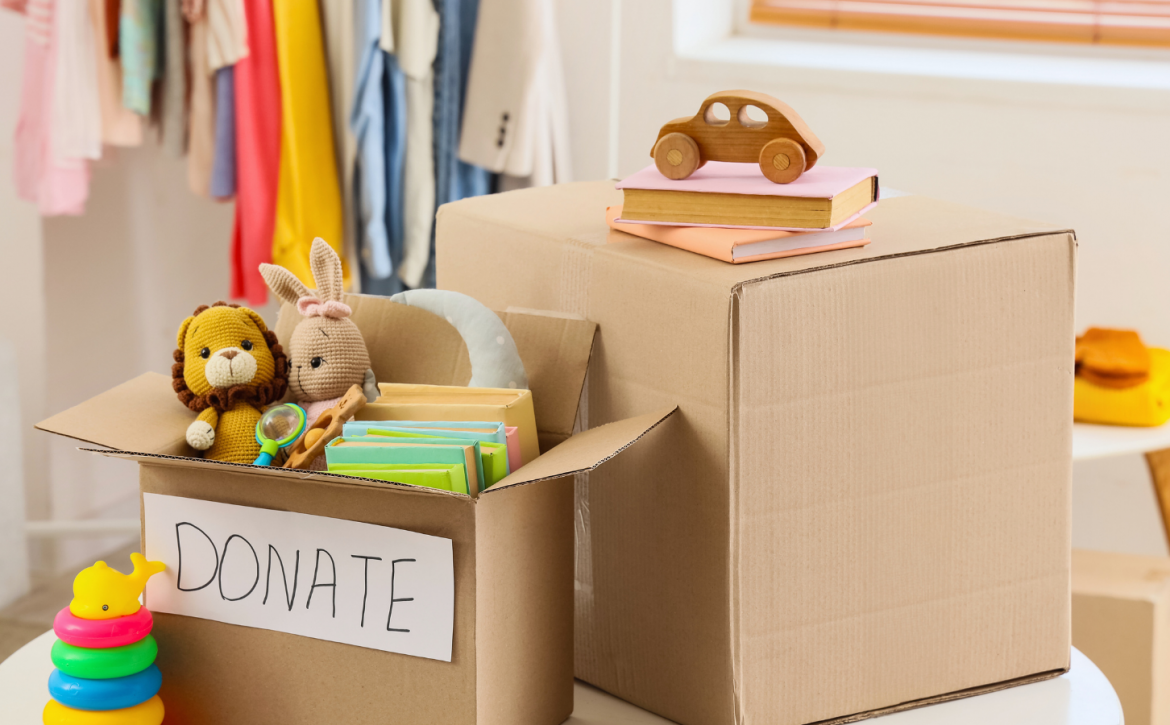
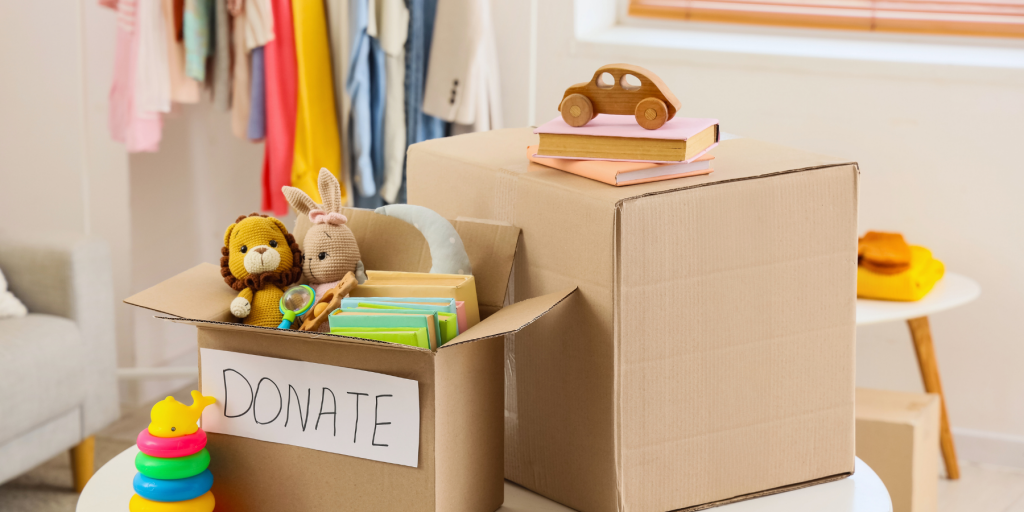
  3. Share what you have. When you pack your unused household items to donate, invite your child to choose a few of their own gently used books or clothes to donate. Your child may struggle with this sometimes — and that’s okay. It can help to make giving less abstract. For example, “I wonder if your friend would be happy to have these ballet slippers that you’ve outgrown.” or “Choose five books that you’re not interested in to leave in the free library, and we can look for new book for you.” Those conversations about fairness, gratitude, and generosity are part of the learning.
  4. Include children in everyday helping. Service doesn’t have to be formal volunteering. Preparing sandwiches for the food pantry, writing a thank-you note to a teacher, or checking in on a friend are all ways of showing up for others.
  5. Give and receive. Being a part of a community means giving AND receiving. When my daughter receives trinkets from a friend or watches me receive baby clothes from a neighbor, she learns first-hand how it feels to receive help from others, which encourages her to share more.

Why This Matters, Especially Now

At Sparkler, we believe that children are capable of understanding big ideas when they’re introduced with warmth and respect. Service builds more than empathy, it builds confidence, communication skills, and a sense of purpose. When children experience themselves as helpers, they begin to see that their actions matter. They can be a hero to someone else!

And for parents and caregivers, practicing service together can be grounding. It reminds us that even in seasons of exhaustion, we are connected to something larger than ourselves.

On this Martin Luther King Jr. Day, I’m not aiming for grand gestures. I’m aiming for presence, connection, and small moments of service. We will talk about fairness at the dinner table; we will squeeze a small act of kindness between naps and bedtime routines.

On Feb. 4, 1968, Dr. King said, “Everybody can be great because anybody can serve…You only need a heart full of grace, a soul generated by love.” His words remind us that greatness does not require people to achieve prerequisites or achieve at a high level or large scale — it’s about service. And when we invite our youngest children into that work, we’re not just honoring his legacy, we’re helping to build the compassionate communities he envisioned, one small act at a time.

Top Plays 25
December 19, 2025 by Admin 0 Comments

Top Plays of 2025

Throughout 2025, Sparkler families played, learned, and earned Sparkles! 

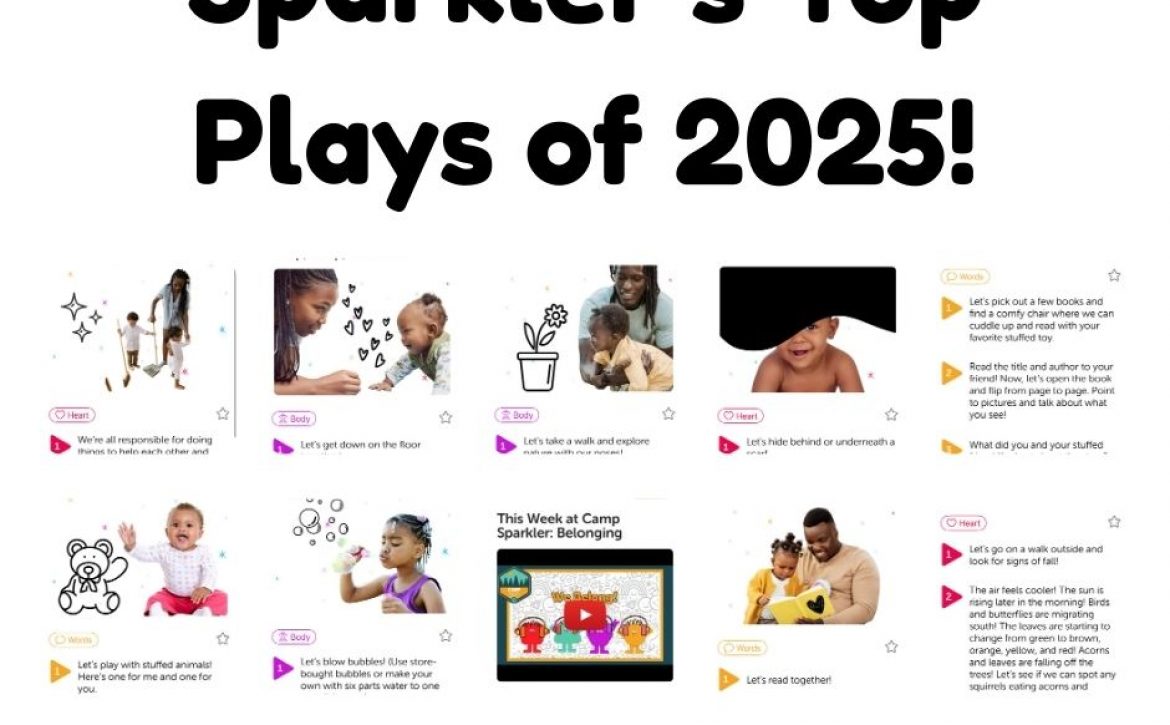
As we approach the end of the year, we’re looking back on the most popular play activities of the year, measured by the families who completed activities and pressed “We Did It!” in the app. The top 10 activities included: 

10. Little Helper

9, Stop, Drop, and Roll

8. Stop and Smell

7. Where Are You? 

6. Read to a Stuffed Friend

5. Allow Me to Introduce Myself

4. Bubbles

3. This Week at Camp Sparkler

2. Read Together

1. Fall Walk

Let’s keep playing, learning, and sparkling together in 2026! 

Image (6)
October 16, 2025 by Admin 0 Comments

Q&A: Learning Through Play in Early Childhood

Sparkler chatted with Jordan Dospil, who is a Senior Content Specialist at the National Center for Families Learning (NCFL), where she creates curricula for the early childhood space. She has a background as an early childhood educator. Sparkler worked together with Jordan and the team at NCFL to create Play With Purpose, a playgroup program for families with young children.

How do you define play?

I think of play very broadly. For me, play is led by the child, keeps their interest, and it’s FUN.

Does play include reading or singing or other activities that don't involve toys?

Yes! Toys can be great, but I think they are completely optional for play. As far as that goes, I think play could even be something that never leaves our heads — that is completely imaginary. My older kids are big daydreamers and that can be a wonderful way to play.

Why is play important for children?

For so many reasons, but the top ones for me are learning and imagining. Imagining is the key to creative problem-solving that we as humans will always need. Aside from that, though, I think it’s essential for us to give kids the time and space to be kids and play is a huge part of that.

You're a mom and early childhood educator. What is the most effective way you've found to read with young children?

My favorite ways to read with young children are to use voices and sound effects and to get them moving during the book. So for sound effects, if a dog is talking in the book I’ll try to make it sound like a dog — barking and howling. If I have wiggly kids, I’ll get them to act out the book — like huffing and puffing to help the wolf blow the house down in “The Three Little Pigs.”

And what are some objects your family likes to use for "play" that aren't traditional toys?

Kitchen supplies are huge — my toddler loves to whisk anything, or use table knives to cut up cheese and things like that. But I think the kind of play we do most involves just ourselves. We play hand games like patty cake or Itsy Bitsy Spider. We pretend that we’re puppies or kittens, or we trade places and she’s the mommy telling me what to do. Last night we were making shadow puppets with our hands.

Sparkler and NCFL — where you work — created the Play With Purpose curriculum to help families "play with purpose" to support their children's early learning and development. What does playing with purpose mean to you?

To me it’s about activating the power of play. You know, kids are learning from us whether we mean them to or not — and they learn through play. I think of the times I’ve seen my kids pretend to go to work like they see me do, or repeat things I say. I’m not trying to teach them those things! But parents really are their child’s first and best teacher. When we can use play meaningfully to teach kids and strengthen our connections with them, that is so powerful.

You've coached many Play With Purpose playgroups over the years. What do you think are the main things that families gain from participating?
One of the big things I see is families recognizing their own power and capability in teaching their children. The other thing is making connections with other families, which can be so hard as a new parent and is so important. 
Last week, we trained Play With Purpose playgroup facilitators in San Francisco! What do you think facilitators gain from facilitating these groups?

I think they learn some new ways to talk to families about the value of play and teaching them new tools to engage their children. For a lot of facilitators, it’s also a new way to connect to families in their community, which helps families access resources and support they need even beyond the playgroup.

Do you have any tips for families who feel like it's daunting to start playing? How can they get started?

I was one of those parents! I still sometimes struggle with imaginative play as an adult. My tips:

  • Start small — even just two minutes at a time can make a difference. (And it’s often easier to keep going once you start.)
  • There are many different kinds of play. Start out by trying what feels right or easy to you.
  • Sometimes a song or book can be an easier way to start because the script is right there. Let your child lead the way.
  • Follow their interests and their lead. You can even start by just sitting next to them while they play and watching and asking questions.

Learn about Play With Purpose in San Francisco

Interested in learning more about the Play With Purpose program in San Francisco?

DanaStewart
July 25, 2025 by Admin 0 Comments

Q&A: The Power of Summer Learning

Sparkler Education Director Dana Stewart and one of her children

Sparkler’s education director, Dana Stewart, spent a long time as a preschool teacher and school leader. She’s also the mom of two amazing young children. 

At Sparkler, Dana creates and maintains the amazing play content and parenting information in the app. She also oversees Camp Sparkler — our summer learning program, which is available for free through the app to all families which children 0-5 years old. 

In this Q&A, Dana shares information about summer learning and Camp Sparkler, and what parents/caregivers can do to promote summer learning with young children.

Sparkler: In your experience, is “summer learning loss” real for preschoolers and young children? 

Dana: Yes! I remember as a preschool teacher, we spend the whole year building up routines. By the spring, children are so practiced that they know exactly what to do in the classroom. If they go away for two weeks, it’s like they never learned the routines. When we think about summer learning loss, we tend to think about older children and academic learning, but the same principles hold true for toddlers and preschoolers. They’re just learning different things in school.  

Sparkler: As a mom and longtime preschool teacher and leader, can babies, toddlers, and preschoolers actually keep learning in the summer months? 

Dana: Yes! Learning never stops with young children. I think that’s why it’s especially important for us — as caregivers of young children — to create opportunities for them to practice the skills that we want to promote throughout the year. 

Sparkler: Why is the summer actually an important time for learning? 

Dana: I think summer offers new opportunities for learning because a lot of us tend to slow down. The hustle bustle of the school year slows; children are less busy. This gives families opportunities to really dig into their children’s interests. We’re also outside more in the summer months, which gives children a chance to explore the natural world freely in a way that is more complicated when it’s colder outside. Summer can be an especially great time to involve children in activities that focus on skills like helping others, being a good friend, or calming down when they’re upset.

Sparkler: Why have you built the Camp Sparkler program around Sparkler’s Little Kids, Big Hearts podcast this summer? 

Dana: The podcast is amazing and I’m delighted to be able to shine a light on it with camp this year. Todd Loyd, the podcast host, is a preschool teacher, and he’s so great with the kids featured in each episode. To be able to hear the children’s ideas and experiences — in their own words — makes the podcast engaging for kids. My child and I both enjoy listening — and it helps me, as a mom, to hear how my own child thinks about these big ideas related to our “hearts,” or social and emotional learning. 

Sparkler: Sparkler emphasizes play — why is play important in the Camp Sparkler program? 

Dana: Play is how children learn best. I think play is how everybody learns best. The physical experience of play is the best teacher. It’s the joyful self-directed practicing of skills that helps to crystalize new information. It generates new ideas and is the birthplace of creativity and ingenuity. The fact that play is FUN is maybe the most important aspect of play. We are motivated to play because it doesn’t feel like a chore. Playing WITH people you love is even better. 

Sparkler: People are busy — how much time does a busy parent or caregiver have to spend playing with a child in order to make a difference? 

Dana: The good news is that it doesn’t take much time at all. Even five or ten minutes a day can make a huge difference. The best is when you can spend a few minutes playing with your child and then set them up to continue playing, thinking, and processing independently for a few minutes. 

Sparkler: What are some of the highlights of Camp Sparkler this year? 

Dana: There are SO MANY new play activities, but I am especially excited about all of the music that we’re featuring this year. Benjamin Weiner and Bill English who wrote and performed the songs (along with featured podcast actors) are so great. My own kid loves the songs, and I’m sure others will, too!

Sparkler: This will be your fourth summer leading Sparkler’s summer learning program. What brings you joy about Camp?

Dana: My favorite thing about camp is creating new play activities I’m really excited about and sharing those with families — and seeing their excitement as they play them together. 

Sparkler: How can families access Camp Sparkler?

Dana: If a family already has a Sparkler account, they’ll see Camp Sparkler activities on their app home screen on July 7, 2025 through the end of August. If a family doesn’t have a Sparkler account, they should create one, linking up with their local school or program and then they’re all set. (There’s more information here.) Families can start anytime over the summer. It’s okay if they miss the first day or week. If anybody has questions, just reach out to support@playsparkler.org.

dentistoffice
February 11, 2025 by Admin 0 Comments

Ask a Dentist!

This February, in honor of National Children’s Dental Health Month, Sparkler chatted with Dr. Alison Nicholes, a dentist in Hebron, CT, who has been caring for children’s dental health and hygiene for 18 years. 


Sparkler: What are some of the big questions you hear from parents of young children? 

Dr. Nicholes: I think the biggest questions from parents are usually about timing. Parents wonder when to start brushing and when to schedule first dental visits. 

Sparkler: When should brushing start? 

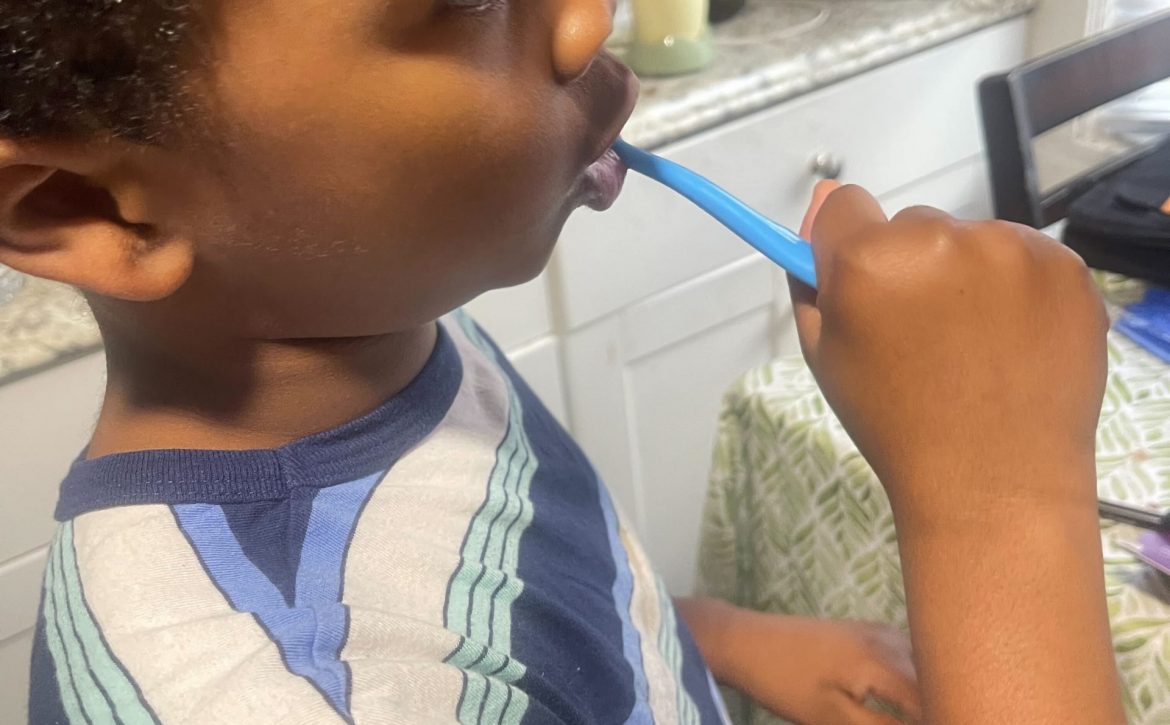
Dr. Nicholes: The sooner you start with any sort of dental routine for your children, the sooner they adjust. Dental behaviors are habits that need to be formed and reinforced daily. Wiping a baby’s gums in the evening with a clean washcloth or a very soft introductory toothbrush can help start this process. Once there are teeth, a very soft infant toothbrush is appropriate. I like to advise patients to initially start with a very small amount of non-fluoridated practice toothpaste so a child learns to associate a taste with brushing. The amount of paste should look like a grain of rice to start. When a child masters being able to spit out the paste, you should switch to a paste with fluoride to help strengthen the teeth against decay. 

Sparkler: When should children visit the dentist for the first time? 

Dr. Nicholes: Sometimes we hear from our patients that their physicians advise children to start at their first birthday. This can be helpful if you need advice about dental care and habits at home. Typically, a child at age two is more successful in a dental visit and for some kids, it will be even a bit older than age two that they will be willing to sit for their first cleaning. Bringing a child to their sibling’s cleaning or even your own can be a great tool for modeling the behaviors needed to have a good visit at the dentist. If your child can’t cooperate for their first cleaning, usually just more time is needed for them to grow and mature. I recommend trying again in six months. 

Sparkler: Is there anything parents should do or avoid to support their children’s dental health? 

Dr. Nicholes: Parents who model regular dental hygiene at home for themselves have an easier time helping reinforce these habits for their kids. Brushing and flossing your own teeth with your child benefits you both. 

Sparkler: What are the guidelines around pacifiers for dental health? Or bottle use? 

Dr. Nicholes: In an ideal world, kids would discontinue use of bottles and pacifiers around their first birthdays. This is not what I typically see many families do as there is a lot of stress and anxiety around the loss of these comfort objects. Limiting their use after the first birthday is the best for their dental health. If your child is older and is still working on this, don’t beat yourself up. Start by setting a date in the very near future and work on a plan to being fully pacifier and bottle free.

3
December 20, 2024 by Admin 0 Comments

New Year, New Goals for Parents & Caregivers

Setting goals is important in all parts of our lives — including parenting and child development — and the start of a new year can be a perfect time to make some resolutions about our parenting and our children’s learning and development. But just like for other types of resolutions (around health and fitness, reading more books, getting organized, etc.), getting a goal to “stick” and lead to accomplishment, isn’t easy. 

Here are six steps families can use to establish and achieve goals as we prepare to enter a new year!

Consider Your Top Concerns

Before setting goals, take time to reflect on what matters most to you and your family.

  • Are you worried about your child’s early learning and development, social skills, or social and emotional learning? What specific concerns do you have? It can be useful to complete an Ages & Stages Questionnaire (ASQ-3 or ASQ:SE-2 or both) on Sparkler to understand how your child is developing and identify your areas of concern.
  • Are you focused on your own parenting habits, such as staying patient during stressful moments or maintaining routines for your family?

Identifying your main concerns will help you focus your energy on goals that will make a difference for your child and your family.

Set a Big (But Achievable) Goal that Addresses Your Concern

Once you’ve identified your concerns, think about what success would look like and how you can set goals that are within your control as a parent. That is, parents cannot control how fast children learn and grow, but parents can control what they — as grown-ups — do or don’t do.  The key is to set a goal that feels meaningful and challenging, yet realistic and within your control.

For example: 

  • Instead of a big goal of “my child will be on track in her gross motor skills,” consider something more specific that you can practice and learn together like: “My child will be able to walk up the stairs in our home.”
  • Instead of a big goal of “My child will be able to express himself in full sentences,” consider something that you can control as a parent, such as: “My child and I will communicate better.”   
  • Instead of a big, broad goal of “I will develop a stronger bond with my child,” consider something that you can control like: “My child and I will spend more time playing together.” 
Break Down Your Big Goal into Smaller Goals

Just like going from zero gym visits per week to seven per week overnight can be a recipe for failure, setting a big goal for parenting or child development can also be daunting. The trick that can help you succeed is breaking down the big goal into smaller goals that you can take on, one by one.

Here are some examples, building on the big goals in the previous section:  

  • Stairs: Smaller goals could be practicing stepping up onto a curb together every day, stepping over a small (1-2 inch) obstacle together, practicing balancing on one foot to a count of three, practicing going up the steps at the playground, etc.
  • Communication: Smaller goals could be playing with your child for 10 minutes each day, asking open-ended questions and waiting for your child’s response after reading a book together, or talking with your child while cooking meals or walking to school. If you think your child could benefit from early intervention or other services for speech, you could talk to your healthcare provider and learn about the options. 
  • Play: Smaller goals could be reading together every day, playing with your child for 10 minutes every day, or trying new “calm down” activities like deep breathing or taking a walk outside together each day.

Achieving these smaller milestones will build momentum toward your larger goal.

Share Your Goals to Get Support from Family, Friends, Teachers, or Others in Your Child's Life

Accountability and encouragement can go a long way in sticking to your goals. Share your plans with trusted members of your “team,” who can provide support and guidance. For example, your child’s teacher might have valuable tips or a spouse or sibling might partner with you in achieving your goals or cheer you on. Involving others also helps create a sense of shared purpose that can help you to achieve your small goals and your big goals.

Measure Your Progress and Reward Yourself for Success

Tracking your progress is essential for staying motivated. Whether it’s using a chart, journal, or app, find a way to measure your achievements. Celebrate small successes along the way to keep the momentum going. Rewards can be as simple as a family movie night or a special outing to the park to recognize everyone’s hard work and dedication.

You Can Do It!

Finally, remind yourself and your family that reaching goals takes time and effort. There will be setbacks, but persistence and a positive attitude make all the difference. Celebrate your growth, even if progress is slower than expected. Every step forward is a victory, and with determination, you can achieve your goals and make this year a memorable one for your family.

holiday stress
December 19, 2024 by Admin 0 Comments

Keeping Routines to Keep the Holidays Joyful

Kate Sweeney, MSW, LCSW-C, Assistant Extension Professor, Co-Director, Parent Infant Early Childhood (PIEC) Innovations Institute University of Connecticut, School of Social Work

Sparkler chatted with Kate Sweeney, the co-director of the Parent Infant Early Childhood Innovations Institute at the University of Connecticut, School of Social Work about the holidays — which can be a joyful, celebratory time, and also an overwhelming, stressful time for children and families. “While the holiday season is an exciting and joy-filled time, we can often underestimate how overwhelming it can be for kids, especially the youngest. A big part of that is because these special events and celebrations remove us from our regular routines,” she explained. “Routines offer predictability and consistency for children, which helps them feel safe, secure and in control.” 

Sparkler: Why is maintaining a routine important for kids during the holidays?

Sweeney: Routines offer predictability and consistency for children, which helps them feel safe, secure, and in control. Children don’t get offset by an event itself, it is more about the lack of predictability and routine. This can feel confusing and frustrating for adults: “You love trains, why are you throwing a tantrum when we made the effort to go see this train display?” But if we re-frame our response, and remember that a child’s behavior in the moment is likely expressing a moment of dysregulation due to lack of routine, it can help us feel less frustrated, stressed and annoyed as parents, and instead meet our children with calmness and compassion for how they are feeling.

Sparkler: How can we manage holiday activities while still sticking to a routine?

Sweeney:  Some holiday traditions depend on kids being on their best behavior in new or less-familiar settings. Think about the lengthy services; parties with people who might be new or unfamiliar; different food and meal structure; and travel that can disrupt a child’s rest or nap time. 

The key to engaging in these activities, while also protecting your child’s routine as much as possible, relies on two key factors: PLANNING and BALANCE. 

By “planning” we mean literally looking at the weekend or holiday, with your child’s schedule and temperament in mind. What is moveable to accommodate the parts of your child’s routine that they are most dependent on for a successful day?  If it is nap time, and an event starts in the middle of that time, is it possible to get them to rest earlier that day, or to tell the host that you will be there a little late? Is it best to leave the night before rather than waking your child up a few hours earlier than typical for travel? 

By “balance” we mean planning a balance of active and calm parts of your child’s day — even if the routine will be modified. If you have family visiting and there are parties to attend or activities to do together, can you spread the many new activities over two days rather than all on one busy day? 

It’s also important to be aware of your own self-regulation needs.  When you are aware of your own needs, you are ready to help your child(ren). Our kids naturally respond to us (it’s biological!) so if we are stressed or tense (which can sometimes happen over the holidays!), we cannot expect them to be calm and rational.

Sparkler: What if my child is having trouble adjusting to the holiday changes?

Sweeney:  Kids, especially young children, are going to demonstrate to you that they are having a bit (or a lot!) of a hard time with the additional activities and adjustments to their usual routine. It is so important to remind ourselves that behavior has meaning and is communicating a need. What does my child need right now? Are they hungry, tired, hot, overstimulated, bored? We would respond to all of these in different ways, so consider that in your response, always letting your child know you understand how they feel and even though they are upset, you are calm and can handle their moment of distress.

Sparkler: How can I keep bedtime routines consistent during family gatherings or while traveling?

Sweeney:  Some of this will vary greatly if you are traveling away from the space where your child(ren) typically sleep for bedtime, or if they will be staying put in their familiar bed/room/home. You should start by considering what is going to matter most to your child: is it a particular blanket, particular sippy cup, particular music or white noise app on your phone, or a certain hour that they need for transitioning into sleep? If you are in a new location, it is natural that your child will take a bit longer to fall asleep (this happens to us, too!) so don’t get frustrated. Instead, plan for it and you will be more calm in handling the disruption. Another thing about bedtime is timing. Consider what is occurring right before you are asking your child to fall asleep. Can you arrive to a friend or family member’s home in the afternoon, rather than 30 minutes before you are asking your toddler to fall asleep in a new setting? If you are staying home, but having people over, think about some strategies that can make it easier to maintain consistency in your child’s bedtime routine.

Sparkler: How can I manage sensory overload during holiday events?

Sweeney:  Sensory overload during the holidays is sometimes unavoidable. You will be going to places (even the grocery store!) that are more crowded than usual. Lines can be longer, decorations can be bright and lights can be blinking. All of this is beyond our control. One thing that is always in our control is how we respond to our child in their moments of dysregulation. Take the time you need to calm yourself, remembering that behavior (no matter how disruptive) is communication. What does your child need right now? And what typically works to calm and soothe them? Keep that in mind — or if it’s a physical thing like a stuffed animal or a favorite book — make sure that you have it with you so that you’re ready to help your child. Preparing is like checking the weather forecast before packing for a trip! And if your child(ren) are particularly sensitive to sensory overload, try to plan accordingly. Consider if you need to go to a busy store or tree farm when it is most busy. 

Sparkler: What strategies help when my child struggles with transitions during busy holiday days?

Sweeney:  Keep in mind the importance of expecting and understanding that the holidays can be both exciting and overwhelming for children (and adults!) and that this can be due to overstimulation, increased social demand, and disruption to an established routine. 

Remember to anchor your response to your child in understanding. For example, you can say, “I know you were excited to see Santa, but the line is very long and it is hard to wait.” You can also prepare yourself with the things that support your children to calm down and regulate. This can be different for different kids, but you know your child best.

As you navigate routines during the holidays, remember that flexibility and patience are key to a joyful season. Embrace the imperfections, try to tolerate the tantrums that are sure to occur, and focus on creating special memories with your child(ren).

gratitude (1)
November 21, 2024 by Admin 0 Comments

5 Steps to Grow Gratitude in Young Children

Gratitude — feelings of thankfulness — helps children (and all people) feel less stressed, more optimistic, and happier. Listen to Sparkler’s new song — “I’m Grateful” and learn five ways to help children practice gratitude (also available in Sparkler’s tips for adults in the mobile app). Parents/caregivers using the Sparkler app can find these tips under Tips for Adults in a unit called Growing Gratitude. Providers using Sparkler can find and share it from Sparker’s library on the web-based dashboard. 

1. Say "Thank You" instead of "Good Job"

When your child does something that makes your life easier, like picking up toys, climbing into the car seat without protest, or not splashing water out of the bathtub, thank him or her! Being specific about what your child has done will help your child know what to do next time. Expressing your gratitude will also help them understand how their behavior affects other people.

2. Make Giving a Habit

Sharing can be hard for young children, so try not to force your child to share. Rather, when your child is moved to offer you a bite of his or her lunch or offers a toy to a friend, talk about how your child’s generosity is having a positive impact on others. You can say things like, “Look at how happy your friend is when you share your snack! You really made them smile!” This will make conversations about larger gestures of generosity easier. As your child outgrows toys and clothes, talk about passing some unused items to another child. Your child will have room on the shelf for new toys, and he or she will make others happy, too! Practicing generosity helps children to understand what gratitude means. Bonus points if YOU donate, too — you’ll be modeling generous behavior!

3. Thank YOU!

When you express gratitude to your child and to others, your child will be more inclined to follow in your footsteps. Express your appreciation to the people who help you — your partner, a postal worker, the cashier at a store, or a restaurant server. When you say “thank you,” you help your child to understand the meaning of the words. Soon, your child will learn to say “thank you,” and understand what the words mean.

4. Less Is More

Shelves and bins crowded with toys can be overwhelming, and can get in the way of a child’s ability to appreciate any individual toy. You wouldn’t toss your most prized possessions in the junk drawer, would you? If you’re not ready to let go of the extras, try putting some toys away and out of sight. When your child can easily see and access (and clean up!) individual toys, he or she will be better able to appreciate each toy.

5. Say "No" or "Not Today" Sometimes

It’s natural to want to give your child things to make him/her happy! It is easier for your child to learn what it feels like to be grateful when he or she also occasionally experiences disappointment. Help your child make the connection between what happened and the feelings he or she has. You might say, “I think you’re disappointed that I said ‘no’ to ice cream today. You’ve already had a treat today, so let’s save the ice cream for tomorrow.” Then, when it is time for a treat, your child can reflect on the disappointment, and rejoice in the gratitude of the moment!

Power Up
November 21, 2024 by Admin 0 Comments

Practice Gratitude Through Play

Sparkler has thousands of activities designed to help children (5 and under) build important early skills and spark passions. Here are a few (off-screen) Sparkler activities that can help families help their children practice gratitude. Families can find these activities in their Sparkler mobile app, and providers using Sparkler can share them with families via Sparkler’s dashboard. All activities are available in English, Spanish, and Chinese. 

Filled With Gratitude (for children 3-5)

This is a collaborative game to share things we’re grateful for, played with a jar, plus paper and crayons/markers/pencils.

  1. Let’s write or draw people, places, and things we’re grateful for on small pieces of paper.
  2. Now let’s say a few words about each one, fold it, and put it in a jar. Let’s take turns, adding more and more things we’re grateful for into the jar.
  3. Is the jar full? What else are we grateful for?
Family Gratitude Quilt (for children 3-5)

This is a family art project, creating and assembling a paper “quilt” of gratitude.

  1. We’re going to create a family gratitude quilt. Let’s each count out six squares of paper. 
  2. On each, let’s use pencils or crayons to draw something we’re grateful for: (1) something from nature, (2) something related to family, (3) something related to friends, (4) an experience we’ve had, (5) something related to our home or neighborhood, (6) a toy or stuffed animal we have.
  3. Now let’s create our quilt by arranging the squares in a grid and taping or stapling them together. 
Thank You Cards (for children 3-5)

This is a craft activity that can help children to express gratitude. 

  1. There are so many reasons to say thank you! Let’s make and send a thank you note to someone for whom we are grateful. They may have given us something, helped us in some way, or simply been kind. 
  2. Tell me about your gratitude. I’ll write down your words in a card. Then you can decorate it!
  3. Let’s send our thank you note. How do you think the person will feel when they receive this wonderful card?
Thank a Helper (for children 1.5 years old - 5 years old)

Thank people in your community!

  1. Let’s take a walk and look for helpers in our community.
  2. Let’s look for crossing guards, sanitation workers, delivery people, neighbors cleaning the sidewalk, and anyone else who is helping to make our neighborhood better.
  3. When we see a helper, let’s thank them for their hard work!
Thanksgiving Tale (for children 1.5 years old - 5 years old)

Make up a story about foods you love to express thanks for them.  

  1. Let’s think about all the foods we love to eat!
  2. Every time I say a food I love to eat, I’ll say, “mmm-mmm!” and rub my belly.
  3. You do it, too, if you love the food!